
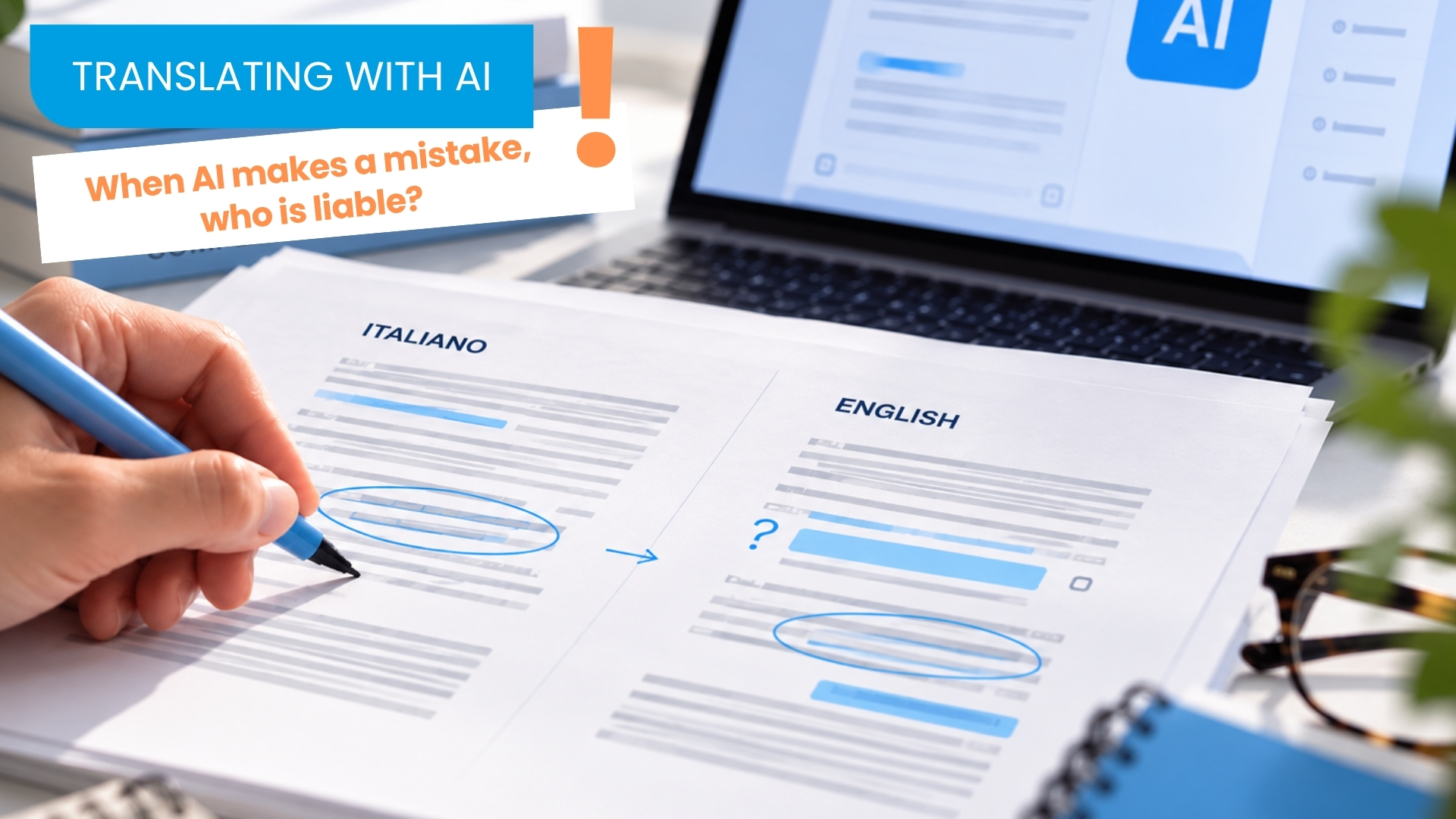
Let’s revisit a topic that has previously been explored in other articles – one that is becoming increasingly relevant in the translation world too: AI. This time, the question is simple: who is liable if AI makes a mistake?
Let’s start with one basic fact: AI can make mistakes.
Today’s generative AI tools have been found to be highly effective at producing texts in a variety of languages. They demonstrate excellent writing skills, employing precise grammar and a assured tone. However, a translation can look flawless at first glance and still contain misinterpretations, omissions or even errors that alter the meaning entirely.
In a business context, the real risk is using AI without proper oversight and forgetting that liability for the content still lies with whoever uses and publishes it.
Translating technical documentation, an international distribution agreement or a medical device instructions for use demands particular care due to the potential consequences of an error. These may include operational, contractual, financial and, in some cases, legal implications.
When a company chooses to forgo professional translation review in an effort to save time and money, there are three potential consequences to which it may be exposed:
- Operational risks: an inaccurately translated user manual can lead to the incorrect operation of a machine, potentially causing malfunctions or accidents.
- Regulatory and legal risks: a poorly translated contractual clause can alter the meaning of rights, obligations or penalties and give rise to complications in the event of a dispute.
- Reputational risks: approaching an overseas customer with marketing materials containing expressions that are out of context or inappropriate for the local culture can have a detrimental effect on the company’s professional reputation.
When a translation error results in financial or reputational damage, one question inevitably comes to the fore: who is liable?
AI does not sign contracts or assume liability
AI doesn’t sign contracts, nor can it automatically be held liable for the content it generates. In the event of damage, it is necessary to assess the roles of those involved, their contractual obligations, how the tool was used and the applicable legal provisions. Relying on automated output without implementing adequate checks therefore increases the risk. In any event, it should be noted that this does not determine who will ultimately be held liable.
Human oversight, therefore, should not be viewed as a hindrance; rather, it should be recognised as a safeguard.
Through post-editing and revision, a language professional can:
- Spot AI “hallucinations” and logical or terminology errors.
- Check the text for consistency and, where necessary, verify its compliance with the regulatory and linguistic requirements of the target market.
- Review and approve the text before publication, particularly in the case of technical, legal or medical content, or material with a potentially significant reputational impact.
The new European AI Act landscape: transparency and compliance
The issue of liability must now also be considered within the EU’s new regulatory framework for artificial intelligence. The AI Act entered into force on 1st August 2024 with the majority of its provisions taking effect on 2nd August 2026, although certain obligations are subject to separate deadlines.
The provisions now in effect include specific transparency obligations for certain systems and AI-generated or AI-manipulated content. However, there is no blanket requirement to disclose every use of AI. The applicable rules depend on the type of system, the nature of the content and the manner in which it is used or published.
The AI Act imposes compliance and transparency obligations, but it does not automatically determine who must compensate for damage caused by an incorrect translation. Liability must be assessed in light of civil, contractual and sector-specific rules as well as those governing safety and product liability, where applicable.
For businesses, this involves even greater care over the use of AI tools, including the data and content they process. It is also important to note that compliance with the AI Act is not the only consideration in this regard, as data protection rules may also apply.
By choosing language service providers that have clear procedures, robust data-protection measures and human oversight, businesses can mitigate these risks.
At IMAGINE Traduzioni, we leverage the capabilities of AI, working in synergy with the proficiency of language professionals. All texts are subject to a rigorous professional review process prior to publication, ensuring that linguistic quality and data protection standards are met.
Want to talk to us about your project? Get in touch here.
We transcend words.
________________________________________
Don’t want to miss IMAGINE Traduzioni’s next articles?